
Learn entrepreneurial thinking through real-world action.
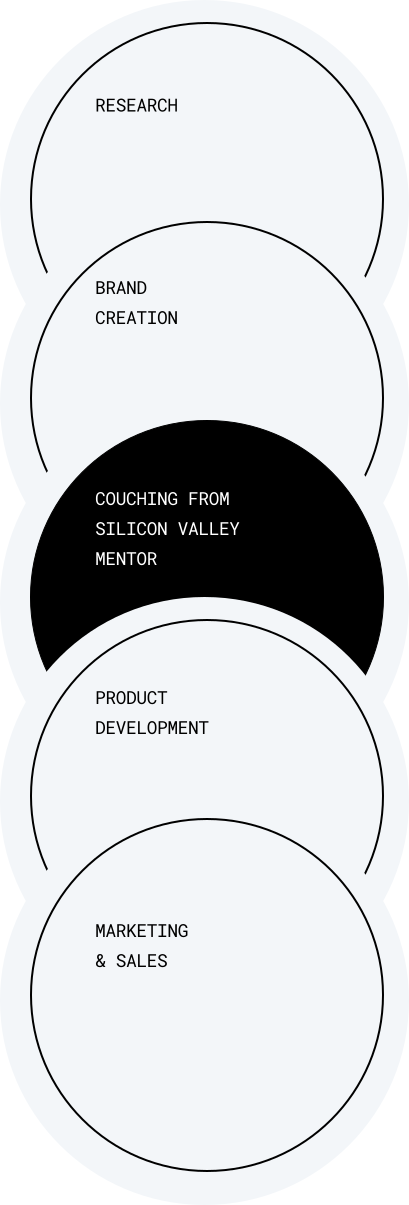
Over three months, students build and launch product-based business in a guided simulation. They use e-commerce platforms such as Amazon as a learning laboratory and work through the full entrepreneurial cycle: market research, product validation, prototyping, unit economics, and go-to-market strategy. Along the way, they learn to spot opportunities where others see problems and turn that thinking into measurable outcomes.
As a result, students learn to think like founders. The goal is not to train sellers, but to build the mindset and skills that translate to any career path.
As a result, students learn to think like founders. The goal is not to train sellers, but to build the mindset and skills that translate to any career path.

Applications are open for April 2026
Age groups: 15–17 and 18–22
Program fee: $3,000 (USD)

What’s included
in the $3,000 fee
in the $3,000 fee
12-week program: screencast modules, weekly live sessions, mentorship, and homework feedback, plus AI tools, templates, and access to the digital learning platform. The fee also includes sample production and delivery to students.
Early-bird pricing available until 28 February 2026.
Our youth practicum is built around the U.S. market - one of the most competitive environments for learning. What you learn here applies across markets.
The program runs in Russian. English is required to work with research, analytics, and selected materials.
Apply for April 2026.
Early-bird pricing available until 28 February 2026.
Our youth practicum is built around the U.S. market - one of the most competitive environments for learning. What you learn here applies across markets.
The program runs in Russian. English is required to work with research, analytics, and selected materials.
Apply for April 2026.
Artem Goldman
Tech entrepreneur. Forbes 30 Under 30 USA. Projects: VisaBot, Wonder Family. Alumnus of Skolkovo and 500 Startups (Silicon Valley).
Mentorship
Our mentors are real entrepreneurs behind $10M–$100M companies. Your teen will learn directly from founders who’ve raised capital, scaled brands, and built successful businesses.
Yulia Sitnikova
Head of Acceleration (Products Team) at Wonder Family (USA). 4+ years of experience leading entrepreneurs through the end-to-end Amazon USA launch cycle: niche research, UVP validation, production and logistics, listing, and go-live.
Yulia Popova
Brand, product, and commercial strategy professional with 8+ years of experience across FMCG and global e-commerce. Extensive international experience in US, European, and CIS markets. Led brand and product initiatives for Wonder Family, Henkel, and Adidas Group.
Tatiana Nudelman
Co-founder of Global Future Entrepreneurs. Entrepreneur with 20+ years of experience. British Higher School of Design (Moscow), PR and marketing lecturer. TEDx speaker. Skolkovo Startup Academy alumna.
and 12 more entrepreneurs
parents say
My child is applying to a strong program, university, or internship, and we want a more convincing profile.
we respond with
A certificate of completion plus a documented entrepreneurial case. A real project with decisions, results, and a clear narrative you can reference in applications.
parents say
My child is curious about business, but we’re focused on university and a strong career path.
we respond with
Entrepreneurial thinking is a universal skill. Students learn to make decisions in uncertainty, create value, and build initiative skills that strengthen any academic or career direction.
parents say
My child struggles with consistency and finishing what they start.
we respond with
Weekly milestones, teamwork, and mentor check-ins. Clear accountability and steady progress toward a finished outcome.
parents say
My child doesn’t yet connect money with value and responsibility.
we respond with
Costs, margins, budgeting, and unit economics. Students learn how choices translate into numbers.
parents say
I am not sure I would want my child to be selling products on marketplaces.
we respond with
We use Amazon as a learning environment – a business stimulator. Students develop entrepreneurial thinking using the dynamics of a real market.
What Parents Often Ask
After many conversations with families, we shaped the program around the questions we hear most.
we respond with
parents say
Program Summary & Outcomes
Teams and roles
Outcomes
A steady weekly rhythm
Key Details
Duration:
3 months (12 weeks)
Start dates:
Multiple intakes throughout the year
Program fee:
$3,000 (USD)
Ages:
15–22 (separate age groups)
Language:
Russian (fluent), English: required (B2+)
1
Format: online
2
Time commitment: ~4 hours/week (includes a 90-min live Zoom session)
3
Digital workspace for materials and tasks
4
Progress tracking, feedback, and homework review
5
Group chats for teams and announcements
1
Small teams (~10 students) rotate across roles to understand how real decisions shape outcomes.
2
Analytics, Product (R&D), Marketing, Management, Finance (Unit Economics).
3
Helps each student discover where they create the most value.
Final outcomes:
1
Documented case study (entrepreneurial journey)
2
Pitch Deck (strategic thinking & decision-making)
3
Product sample
4
Real market feedback


What Participants Gain
Learn to take responsibility in uncertainty, work in teams, and deliver results — building resilience, flexibility, and confidence.
Leadership
character
character
Explore analytics, design, marketing, product, finance, and management to find what fits best. No more drifting.
Direction
for the future
for the future
Сreate a real product, launch it in the U.S., achieve first sales, and own a company share.
International
business experience
business experience



Application Process
For job inquiries
hello@fut-global.com
hello@fut-global.com
@Deauville, inc USA. All rights reserve
Discuss interests, goals, expectations, and overall fit.
This is not an interview – it’s a conversation to make sure we’re aligned.
This is not an interview – it’s a conversation to make sure we’re aligned.
Submit your details to start the process.
Parent & Student Conversation
Application


Deauville
We’ll use these details to contact the parent or guardian
Get started
Оставьте заявку на консультацию
Мы подробнее расскажем вам о программе и результатах обучения